Mix-and-match
Explore content in our extensive library and pull it together into your own Jewish ritual booklet that honors and recognizes whatever life has brought your way.
Share a ritual
Add your own original content as a clip to our extensive library - a poem, blessing, or something else entirely. Someone out there is looking for exactly what only you can create.
Support us
with your donation.
Help us build moments of meaning and connection through home-based Jewish rituals.
Featured clips
Passover is a holiday that celebrates the exodus from Egypt in which the Israelites went from slavery to freedom through a series of miraculous events. This exodus was the beginning of the process that led the Israelites to the Promised Land. This transition from slavery to freedom is commemorated through a Passover seder and the practice of eating unleavened bread known as matzah.
In many ways the fertility journey parallels the journey of the Israelites. There are many elements of the struggle to grow one’s family that can make one feel trapped and powerless, while one is constantly dreaming of breaking free and arriving at the Promised Land.
The rituals in the booklet are designed by Uprooted, a Jewish Response to Fertility Journeys, to offer opportunities for connection and healing. They synthesize the themes and practices of Passover with the experiences of a fertility journey. You may want to explore them before the holiday in order to prepare, or you want to engage with them during the holiday itself. We hope that they will offer you much support, comfort and inspiration as you experience Passover this year.
This Passover ritual focuses on the part of the Seder known as the Afikoman. It invites you to rediscover a part of yourself that you may have been forced to ignore during your fertility journey. This ritual includes opportunities for reflection as well as creative expression. You will need a medium or large manilla envelope, pens, an index card or piece of paper, and markers. You may want to perform this ritual in a peaceful setting, and you may want to do so before the Seder so that you can use your creation at the Seder.
Think about which part of yourself you have “put in a bag” and allowed to lie dormant while you have been engrossed in your fertility journey. Write this element on your piece of paper or index card.
The manilla envelope is going to be your special afikomen bag. Please use the markers and pens to decorate in a way that reflects what you are thinking and feeling at this moment. You may want to use images or words. You may also want to have other people write notes to you or use quotes from the Torah or other texts that are meaningful to you. Feel free to put on music and do this in a relaxing and pleasant environment so you can dive into this step of the process.
Once you are done designing the envelope, place your paper/card inside. I invite you to bring this to the Passover Seder and put your Afikomen in the bag along with the paper/card. When it is time to eat the Afikomen and it is removed from the envelope, take out the paper/card as well. Read it to yourself and consider how you can work to bring this aspect of yourself back to life. What can you do to give this part of you that has been dormant an opportunity to be reinvigorated and rejuvenated? You may want to share this with the other people at the Seder, or it might be something that you keep to yourself.
If you will be at a second seder as well, write a second element of your nature that you have set aside, so that you can perform this ritual again.
May the afikomen remind you that you are so much more than your fertility struggles and that you do not need to learn how your story ends in order to engage and invigorate all the aspects of your nature.
This Passover ritual focuses on the ten plagues and the custom to remove some wine from our glasses while reciting them. While struggling to build your family, you may experience a dearth of happiness and moments of joy. Through reflection, visioning, and designing concrete tasks, this ritual invites you to seek out ways to increase the joy in your life. You will need 3 cups of grape juice or wine: one full cup of red, one almost full cup of white, and one cup with just a little bit of white. You will also need 10 index cards and a pen. You may want to perform this ritual in a peaceful setting with table or similar surface and that is free from distractions.
Think of 10 actions that you can do for yourself that will increase the amount of joy you experience in your life. These need not be big things; they can be as small as “having a cup of tea” or “seeing the sunset” or “having dinner with a friend.” These can be things that you do on a regular basis or things that you have not done in a while (or ever). As you think of them, write each one down on a separate index card.
Once you have your cards ready, you may want to pour for yourself three cups of grape juice or wine. One cup with red, which should be full. One cup with white that should be mostly full. Finally, one cup with white that should be just filled a little bit.
First, recite the list of the ten plagues and as you do, you may dip your pinky in the red wine/grape juice and remove one drop per plague to acknowledge the suffering of the Egyptians.
דָּם
dam
blood
צְפַרְדֵּעַ
tzefardai’ah
frogs
כִּנִּים
kinim
lice
עָרוֹב
arove
wild animals
דֶּבֶר
dever
pestilence
שְׁחִין
Shechin
boils
בָּרָד
barad
hail
אַרְבֶּה
arbeh
locusts
חשֶׁךְ
choshech
darkness
מַכַּת בְּכוֹרוֹת
Makat bechorot
the death of the firstborn
Now, let’s add some joy. I invite you to take your cups of white wine/grape juice. Recite your first card and while doing so, take a drop from the cup that is almost empty and place it in the almost full cup using your pinky. You may do this for all ten of your cards.
Feel free to drink your white wine/grape juice and if you would like, the corresponding blessing is below:
בָּרוּךְ אַתָּה יְ‑יָ אֱ‑לֹהֵינוּ מֶלֶךְ הָעוֹלָם בּוֹרֵא פְּרִי הַגָּפֶן
Baruch atah A-donay, Elo-heinu Melech Ha’Olam borei pri hagafen.
Blessed are You, God, King of the universe, Who creates the fruit of the vine.
During Passover, challenge yourself to try to do at least one of these actions that can bring your joy daily--whichever one feels right. I invite you to spend this holiday being sensitive to yourself and embracing small actions that can offer you compassionate self-care.
This Passover ritual focuses on the four cups of wine and their expressions of freedom. Fertility journeys are often bereft of freedom, as the struggle to build your family, may leave you feeling stuck. This ritual invites you to explore what freedom feels like through reflection and the creation of a vision board. You will need 4 blank pieces of paper, tape or glue, scissors, pens or markers, and a few magazines. You may want to perform this ritual in a peaceful setting that is free from distractions, and you may want to have soothing music alongside you.
Take your four pieces of paper and write one of each of these expressions of freedom on the top of the page. You may choose to do this in whichever language you prefer. Design a vision board full of images that you may choose to cut out from the magazines, or that you may draw yourself. You can also write, paste objects on your vision board, or add to them in any way that speaks to you.
Here are the prompts for each board/piece of paper:
As you are creating these images you may want to put on some nourishing music and possibly even sip some grape juice or wine.
You may want to bring these four boards to a Passover Seder and place them on the table or hang them somewhere in the room. If you find that they offer you healing and inspiration, then please place them somewhere strategic and use them after Pesach as well. You may want to place them by your bed so you see them as you fall asleep and as you wake up. Maybe they live in your car and accompany you on your travels. Or perhaps you may want to hang them on your wall or place them where you place other family photos.
If you find yourself at a Passover Seder where you feel comfortable doing so, you may want to share one of these pages during each of the four cups of wine/grape juice.
This Passover ritual focuses on the moment during the Seder when we open the door to Elijah the Prophet and honor Miriam the Prophetess. Fertility journeys can be challenging and may leave you feeling depleted and defeated. This ritual offers you an opportunity for reflection that will ask you to consider what type of support would be most beneficial to you. You will need a big goblet, index cards, and a pen. You may want to perform this ritual in a peaceful setting that is free from distractions.
Place the goblet, index cards, and pen in front of you. Below are a series of questions. For each question please write at least two answers, but feel free to write as many as come to mind. Please place one answer on each card. After you write the cards, place them in a stack nearby.
Question 1: Often during a fertility journey, we are so consumed with and exhausted by the journey that other important tasks may fall by the wasteside (ex. Housework, food shopping, tasks for work, paying bills, etc.)
Question 2: During a fertility journey, whether you are public about your struggle or not, people in your life might not always say the right thing.
Question 3: During a fertility journey it is sometimes hard to recognize the gifts that we have and the inner strength that resides in our hearts. Consider which aspects of your personality have helped you overcome, endure, and triumph over other challenging life moments.
Question 4: During a fertility journey there are things that would make us feel supported and cared for (ex. A hug, or a bouquet of flowers, a thoughtful gift).
After you have written all of these cards, shuffle them and then flip them all over so they are facing downward. On the back of each card, write the name of someone you could ask to do the action that is written on the front of the card. You may write the same person on the back of multiple cards, but it is not ideal to have the same person for all of these tasks.
When you are done, place all of these cards into the goblet–your Elijah’s cup. Each day of Passover you may want to take a card from the goblet and ask the person whose name you associated with that task, to do that action for you. You can explain to them what you are doing and share with them why you chose them. You can also tell them that you would rather not explain, but you would really appreciate it if they would help you in this way.
It may feel very challenging to ask for help, but just like it is challenging for Elijah to go to every Passover seder in one night and yet he triumphs, so can you.
One of the central elements of the Seder is the mitzvah to retell the story of the Exodus from Egypt. There is something uniquely powerful about telling one’s story. It is a transformative experience for the storyteller and the listener alike.
However, the verse that communicates this mitzvah poses a challenge for people on a fertility journey. From Exodus 13:8
וְהִגַּדְתָּ֣ לְבִנְךָ֔ בַּיּ֥וֹם הַה֖וּא לֵאמֹ֑ר בַּעֲב֣וּר זֶ֗ה עָשָׂ֤ה ה֙ לִ֔י בְּצֵאתִ֖י מִמִּצְרָֽיִם׃
Ve’higaditah le’bincha bayom ha’hu leimor, baavour zeh asah Ad-nay li bi’tzeiti mi’mitzrayim
And you shall explain to your child on that day, ‘It is because of what the LORD did for me when I went free from Egypt
This verse places the commandment to tell the Passover story in the context of speaking to one’s child. But, what if one does not have a child? What if your own personal story of slavery is the one in which you try and try to have that child? What if you have not yet reached your own freedom or Promised Land, and therefore you cannot tell your Exodus story to your child?
You can reclaim this ritual of storytelling on Seder night and do so in a way that honors your fertility journey. Instead of telling your story to a child who has already been born, you may want to tell your story to your child that you are longing for and that you are trying so hard to bring into this world. You may want to tell that child that you dream of the story of how you searched for them and how you journeyed toward them. Although you may not know the end of the story yet, share what you feel right in this moment, about the journey you traversed in order to bring them into your life.
showing
1-6
of
49
Page
1
of
9
Featured ritual books

Blessings for IUI / IVF / Family Building
Preview

Key Rituals for Perinatal Loss
Preview
Supporting Someone Through a Fertility Journey
Preview
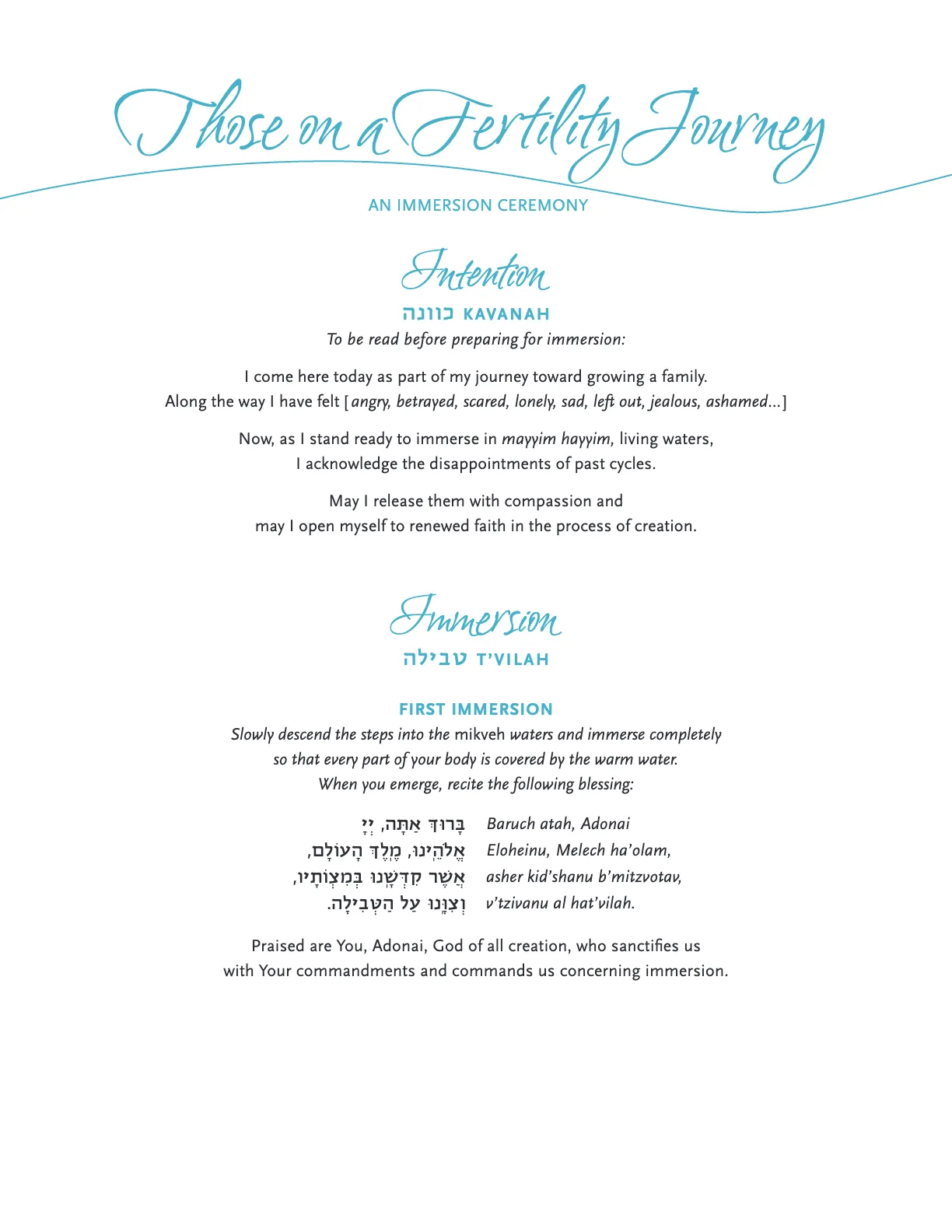
Immersion Ceremony for a Fertility Journey
Preview
Passover for a Fertility Journey
Preview
Navigating a Fertility Journey
Preview
showing
1-6
of
16
Page
1
of
3