Remake of "Joyful Jewish Rituals to Fill Your Cup "
Preview
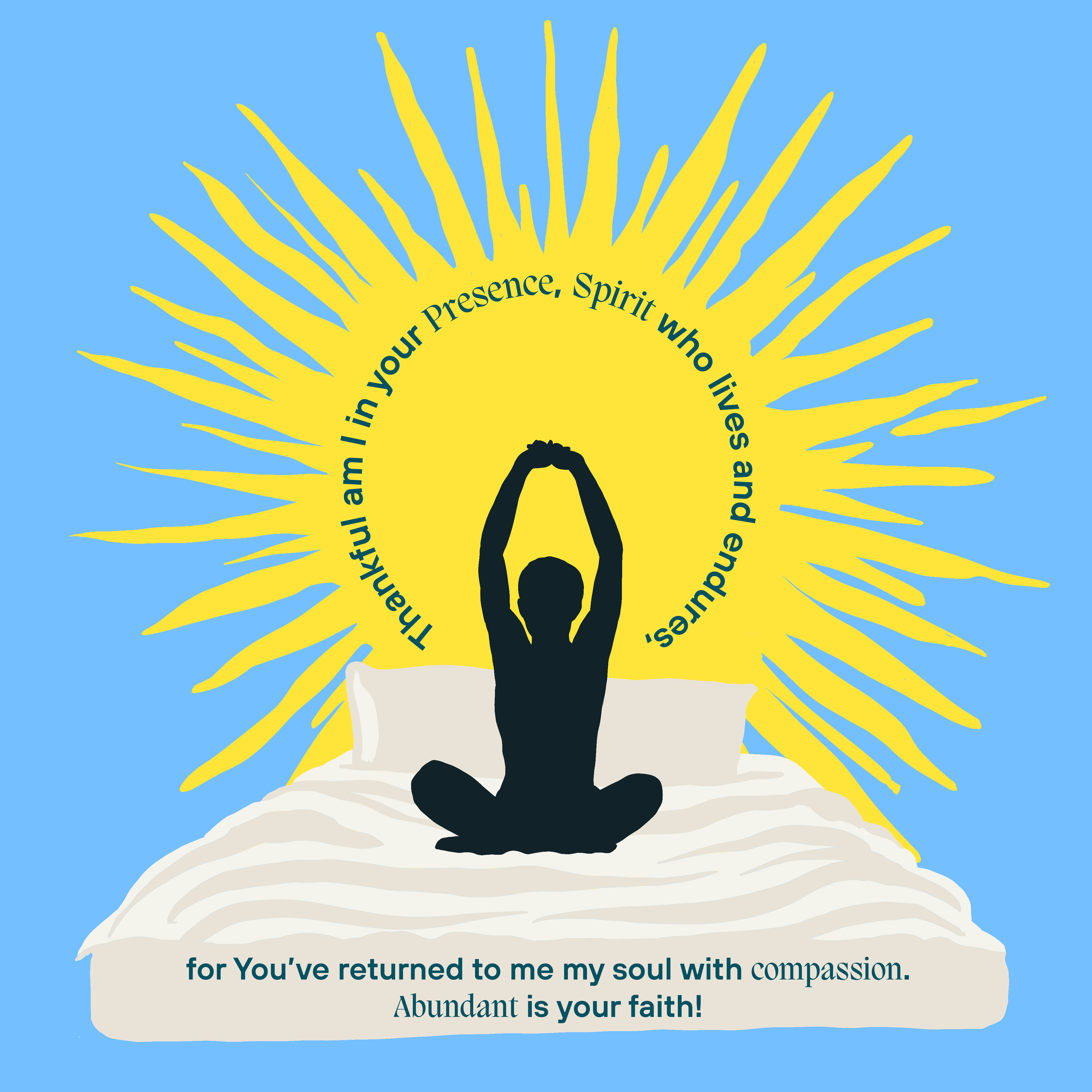
We all know how hard it can be sometimes to wake up in the morning. Taking a few quiet moments before getting out of bed can help reset your mind and start your day with intention. The Jewish morning blessing called Modeh Ani (thankful am I) is customarily recited upon waking.
How to Practice:
As soon as you wake up, before getting out of bed, place one hand on your heart and the other on your abdomen. Take three slow inhales and exhales to center yourself.
Then, say to yourself or aloud, “modeh/modah/modet ani, I am grateful.” Reciting these words is a way to acknowledge that you’ve been given another day, another opportunity and that you’re grateful for it.
Some may prefer to recite the full prayer:
Modeh/modah/modet ani lifanecha, melech chai v’kayam, shehechazarta bi nishmati b’chemla, rabah emunatecha.
Which means: "Thankful am I in your presence, Spirit who lives and endures. For you’ve returned me to my soul with compassion, abundant is your faith!"
When offering blessings or expressing gratitude, feel free to swap in the language that resonates with you most on any given day. You might use words like Source, Beloved, Ruler, Sovereign, Creator, or any other term that feels personally meaningful. You can also say something simple like, “I give thanks for this new day” or “I am grateful for this moment of joy.” The intention is what matters most, so choose words that connect you to the sacredness of the practice in a way that feels authentic to you.
You may also find inspiration from this poem:
Modeh Ani, I give thanks
For quiet, even breaths during the crescendo of morning.
I steady myself as unfulfilled tasks are whispered, then yelled
Outside and inside my chest. I inhale and exhale;
I remember the renewal of the soul and the ancient covenant,
Written in sand, stone, struggle, and guided by 4.5 billion years of echoes
From rock weathered by rain and sun.
I will rejoice in the fragments and exposed cores,
And standing on the ruins, I will sense the swelled springs
Flowing beneath the rocks that Moses struck.
I will greet today with memories of
Lightning and thunder; flashes and rumbles of turmoil and yearning.
I will offer my soul to the crescendo.
Modeh Ani, I give thanks.
In Judaism, ritual handwashing is a practice that symbolizes spiritual purification and is a way to prepare oneself for a sacred act. In our times, we’ve become even more aware of the importance of actual handwashing for good health. While washing your hands, consider reciting the following:
A 20-Second Blessing for Washing Hands by Rabbi Joseph Meszler
As I take up my hands
to wash them and
reassure my heart,
I pray for healing and wholeness
for the whole world.
I remember that every life
is unique and of infinite value:
from those living
on the most remote part of the globe
to those in our cities
to our neighbors and family members.
Let me use my hands for good
to help bring love
and compassion to others.
“Let us lift up
our hearts and hands
to the Eternal.” (Lam 3:41)
Take a minute to set intentions for the home environment or mood you’d like to foster. Many Jewish homes prominently display this classic Birkat Habayit, a blessing-poem for the home. Use it as a guide, or create your own using the prompts on the next page.
Birkat Habayit: Blessing of the Home
Let no sadness come through this gate.
Let no trouble come to this dwelling.
Let no fear come through this door.
Let no conflict be in this place.
Let this home be filled with the blessing of joy and peace.
We all know how hard it can be sometimes to wake up in the morning. Taking a few quiet moments before getting out of bed can help reset your mind and start your day with intention. The Jewish morning blessing called Modeh Ani (thankful am I) is customarily recited upon waking.
How to Practice:
As soon as you wake up, before getting out of bed, place one hand on your heart and the other on your abdomen. Take three slow inhales and exhales to center yourself.
Then, say to yourself or aloud, “modeh/modah/modet ani, I am grateful.” Reciting these words is a way to acknowledge that you’ve been given another day, another opportunity and that you’re grateful for it.
Some may prefer to recite the full prayer:
Modeh/modah/modet ani lifanecha, melech chai v’kayam, shehechazarta bi nishmati b’chemla, rabah emunatecha.
Which means: "Thankful am I in your presence, Spirit who lives and endures. For you’ve returned me to my soul with compassion, abundant is your faith!"
When offering blessings or expressing gratitude, feel free to swap in the language that resonates with you most on any given day. You might use words like Source, Beloved, Ruler, Sovereign, Creator, or any other term that feels personally meaningful. You can also say something simple like, “I give thanks for this new day” or “I am grateful for this moment of joy.” The intention is what matters most, so choose words that connect you to the sacredness of the practice in a way that feels authentic to you.
You may also find inspiration from this poem:
Modeh Ani, I give thanks
For quiet, even breaths during the crescendo of morning.
I steady myself as unfulfilled tasks are whispered, then yelled
Outside and inside my chest. I inhale and exhale;
I remember the renewal of the soul and the ancient covenant,
Written in sand, stone, struggle, and guided by 4.5 billion years of echoes
From rock weathered by rain and sun.
I will rejoice in the fragments and exposed cores,
And standing on the ruins, I will sense the swelled springs
Flowing beneath the rocks that Moses struck.
I will greet today with memories of
Lightning and thunder; flashes and rumbles of turmoil and yearning.
I will offer my soul to the crescendo.
Modeh Ani, I give thanks.
In Judaism, ritual handwashing is a practice that symbolizes spiritual purification and is a way to prepare oneself for a sacred act. In our times, we’ve become even more aware of the importance of actual handwashing for good health. While washing your hands, consider reciting the following:
A 20-Second Blessing for Washing Hands by Rabbi Joseph Meszler
As I take up my hands
to wash them and
reassure my heart,
I pray for healing and wholeness
for the whole world.
I remember that every life
is unique and of infinite value:
from those living
on the most remote part of the globe
to those in our cities
to our neighbors and family members.
Let me use my hands for good
to help bring love
and compassion to others.
“Let us lift up
our hearts and hands
to the Eternal.” (Lam 3:41)
Take a minute to set intentions for the home environment or mood you’d like to foster. Many Jewish homes prominently display this classic Birkat Habayit, a blessing-poem for the home. Use it as a guide, or create your own using the prompts on the next page.
Birkat Habayit: Blessing of the Home
Let no sadness come through this gate.
Let no trouble come to this dwelling.
Let no fear come through this door.
Let no conflict be in this place.
Let this home be filled with the blessing of joy and peace.
showing
1-6
of
26
Page
1
of
5