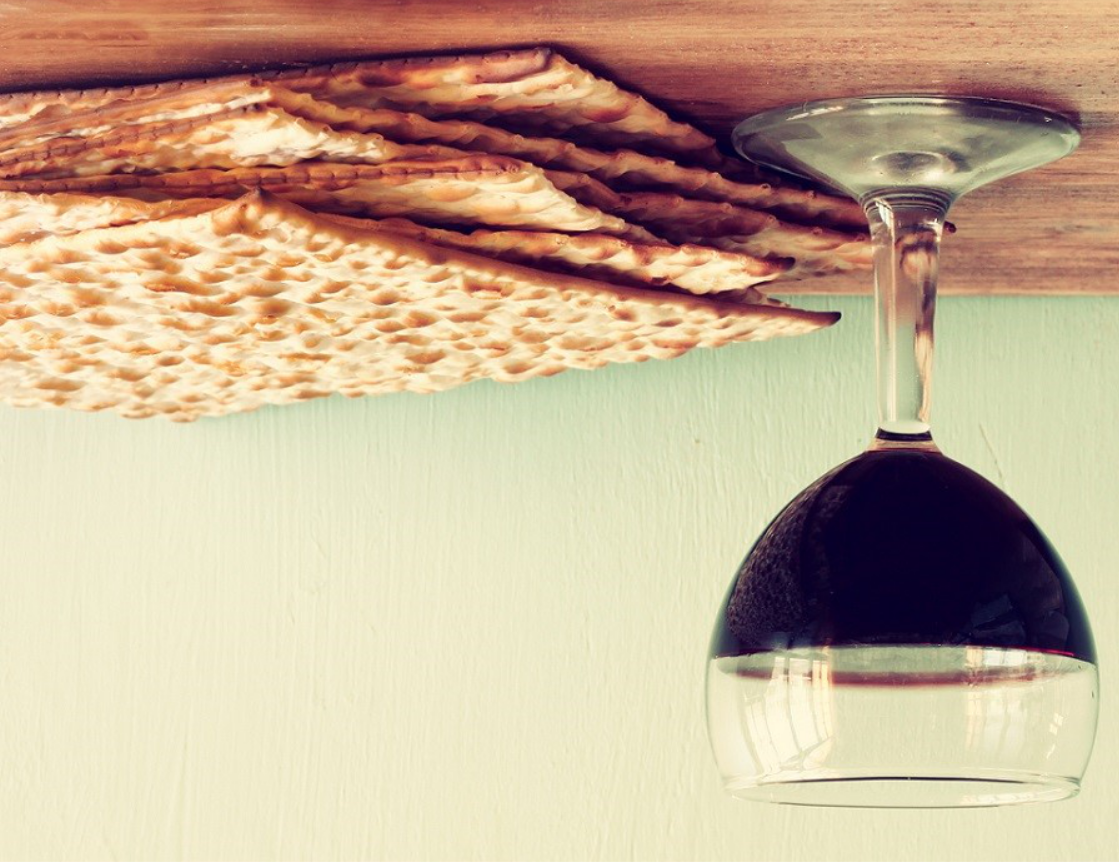
Let's all enjoy some vegetarian, chametz-free food!
Chametz is leavened (risen) foods that are forbidden on pesach. This includes anything made with the grains wheat, barley, rye, oats or spelt that has come into contact with water and been allowed to ferment and “rise.”
This year the food is chametz-free, though not all of it has a kosher for pesach symbols. We decided to do this in order to focus more on the broad ideas of pesach food. Next year, we would love to do vegan chametz-free food!
Some Jews east kitniyot on passover - these include beans, but also some grains and seeds. Examples include rice, corn, sunflower seeds, sesame seeds, soybeans, peas, and lentils. Tonight we have prepared the food without kitniyot, though guests who do eat kitniyot are welcome to bring dishes containing them to share with others who also eat them.
We're now beginning to tell the story of Exodus. We'll be going in the reverse order to usual, starting with a cup of wine, then Dayenu, then the 10 plagues, then the story (we'll do a Play), then the four children, then the four questions!
Drink "2nd" (3rd in Reverse Seder) cup of wine.
Dayenu - IT WOULD HAVE BEEN ENOUGH
One of most beloved songs in the Passover Seder is "Dayeinu". Dayeinu commemorates a long list of miraculous things God did, any one of which would have been pretty amazing just by itself. For example, “Had God only taken us out of Egypt but not punished the Egyptians – it would have been enough.” Dayeinu, translated liberally, means, “Thank you, God, for overdoing it.”
Dayeinu is a reminder to never forget all the miracles in our lives. When we stand and wait impatiently for the next one to appear, we are missing the point of life. Instead, we can actively seek a new reason to be grateful, a reason to say “Dayeinu.”
We'll take part in the fun sephardi tradition of whipping each other with spring onions while we sing a few verses of Dayenu!
Song:
Ilu ho-tsi, Ho-tsi-a-nu, Ho-tsi-a-nu mi-Mitz-ra-yim, Ho-tsi-a-nu mi-Mitz-ra-yim, Da-ye-nu!
If he had brought us all out of Egypt, it would have been enough!
CHORUS: .. Dai, da-ye-nu, .. Dai, da-ye-nu, .. Dai, da-ye-nu, .. Da-ye-nu, da-ye-nu, da-ye-nu!
Ilu na-tan, na-tan la-nu, Na-tan la-nu et-ha-Sha-bat, Na-tan la-nu et-ha-Sha-bat, Da-ye-nu!
If he had given us Shabbat it would have been enough!
CHORUS: .. Dai, da-ye-nu, .. Dai, da-ye-nu, .. Dai, da-ye-nu, .. Da-ye-nu, da-ye-nu, da-ye-nu!
Ilu na-tan, na-tan la-nu, Na-tan la-nu et-ha-To-rah, Na-tan la-nu et-ha-To-rah, Da-ye-nu!
If he had given us the Torah it would have been enough!
CHORUS: .. Dai, da-ye-nu, .. Dai, da-ye-nu, .. Dai, da-ye-nu, .. Da-ye-nu, da-ye-nu, da-ye-nu!
.. .. Dai, da-ye-nu, .. Dai, da-ye-nu, .. Dai, da-ye-nu, .. Da-ye-nu, da-ye-nu!
Adapted from JewBelong Haggadah
NARRATOR 1 (10 LINES)
NARRATOR 2 (13 LINES)
PHARAOH (15 LINES)
SLAVE (2 LINES)
HERALD (1 LINE)
MOSES (8 LINES)
GOD (7 LINES)
PHARAOH’S SON (2 LINES)
AARON (12 LINES)
SHEEP (2 LINES)
YOCHEVED (1 LINE)
PRINCESS (4 LINES)
PRINCESS’S ATTENDANT (4 LINES)
MIRIAM (4 LINES)
-----
1NARRATOR 1: The story of Moses and the Exodus from Egypt has been told thousands of times. It’s a reminder to the Jewish people that once we were slaves in Egypt, but now we are free. And so, this year, as in years before, generation upon generation, we tell the story of Passover. Now, I invite you to relax and listen to this tale. We begin in Pharaoh’s Palace.
2PHARAOH: Yes, I’ll have more grapes. This morning I took a tour of all of my new pyramids and I’m totally exhausted.
3SLAVE: Yes, your highness. I must tell you that as a slave, we are really doing a fine job at building those pyramids. Carrying bricks is just the discipline that my fourteen sons need.
4PHARAOH: Fourteen? Did you say fourteen sons?
5SLAVE: Indeed I did, your most fabulousness.
6PHARAOH: Leave my quarters. I’ve gotta think. This could be bad...really bad. I mean, I love having these Hebrew slaves, but there are just SO many of them! They are not Egyptians, and as shocking as it might be, I don’t think they even like me. What if there’s a war and they join my enemies and fight against me? I am going to try to find a way to decrease this Jewish-Hebrew slave population.
7HERALD: Hear ye, hear ye. It is hereby decreed by Pharaoh, ruler of the land of Egypt, that any son born to a Jew is to be drowned in the Sea of Reeds.
8ALL: NOOOOOOO!!!!!
9NARRATOR 2: Our story continues at the banks of the Nile River, where we meet Yocheved, a Jewish woman with a newborn son.
10YOCHEVED: (distraught) Oh no! Did you hear about Pharaoh’s awful decree? I knew he was mean, but now he’s killing our babies?! I need to hide my beautiful baby boy.
11NARRATOR 2: So Yocheved wove a basket of reeds, which is another word for long bamboo-like sticks, put her son into it and hid it in the tall grass by the river. She then sent her young daughter Miriam to hide nearby and keep watch. The Pharaoh’s daughter, who was a princess, eventually came down to the water to bathe and heard cries coming from the river.
12PRINCESS: What is this?
13PRINCESS’S ATTENDANT: It appears to be a baby, your highness.
14PRINCESS: A baby?
15PRINCESS’S ATTENDANT: Why, yes, your highness.
16NARRATOR 2: She pulled the baby out of the water.
17PRINCESS: Oh, it must be one of those Jewish babies that my dad, the Pharaoh, wants to kill. But look at this little guy. He seems so beautiful and innocent. I know, I’ll take him home and raise him as my son. He will love me and respect me as his mother.
18PRINCESS’S ATTENDANT: As you wish.
19MIRIAM: (as she comes out of her hiding place) Excuse me, your majesty, but would you like me to call a Hebrew woman to nurse the baby, so that your attendant can continue to tend to you instead of being distracted by the baby?
20PRINCESS: Good idea. I hadn’t thought of that. All right, your Hebrew woman may nurse my child, and when he is old enough to walk, she shall bring him to the palace for me to raise. I am going to name him “Moses,” which means “drawn from the water.”
21PRINCESS’S ATTENDANT: Whatever you say, your majesty.
22NARRATOR 1: And so Yocheved’s son, Moses, grew up as the Pharaoh’s adopted grandson, with all the riches and prestige that such a position entailed. But when he was young, Yocheved told Moses that he was Jewish, so he always had great compassion for the Hebrew slaves. One day, he came upon an Egyptian guard beating an old Jewish slave. Moses got so angry that he killed the guard. Of course, by doing so he was breaking the law. He feared the consequences, so he ran away ran away from the palace into the desert, and became a shepherd. That where we pick up the story now.
23SHEEP: Baaaa
24NARRATOR 2: One fine morning, one of Moses’s sheep strayed a bit from the path.
25SHEEP: I said, “Baaaa!”
26NARRATOR 2: Moses followed the sheep and came across a burning bush. It was the craziest thing. This green bush was on fire, but instead of burning up and getting all crinkled and then black, it stayed green. This was, of course, a miracle. It was God, getting Moses’s attention so that he could talk to him. It worked.
27GOD: Moses! Moses!
28MOSES: Here I am.
29GOD: I am the God of thy father, the God of Abraham, the God of Isaac and the God of Jacob. I have seen the affliction of my people in Egypt and have heard their cry. I have come to deliver them out of the hands of the Egyptians, and to bring them out of that place unto a good land, flowing with milk and honey. Now, Moses, I need you to go back to Pharaoh and tell him to let the Jews go free and then you will need to lead the Jews out of Egypt.
30NARRATOR 1: It’s important to know that Moses stuttered whenever he spoke, so he was always nervous to speak in public.
31MOSES: B-b-but why should… I mean, why, why should I be the one t-t-to lead m-m-my people?
32GOD: Fear not – I will be with you.
33MOSES: Whah-what shhhould I t-t-t-ell the p-p-people?
34GOD: Just tell the Children of Israel, also known as the Jews, also now known as the slaves, that they need to listen to you, because you speak for me. Tell them to leave their homes and everything they have always known and follow you to the wilderness.
35MOSES: That is c-c-c-c-crazy. They’ll n-never l-listen and besides, I am s-s-s-s-s-low of s-s-s-p-p-peech and s-s-s-s-low of t-t-tongue.
36GOD: You’re right, it will not be easy. I forgot to mention Pharaoh is not going to simply agree to let his slaves go free. He will take some convincing, and it will not be pretty.
37MOSES: Puh-puh-puh-please send s-s-s-someone else…
38GOD: Your brother Aaron speaks well, right? He will have to help. I will only speak to you, but you can tell Aaron what I said, and he can be the one who speaks to Pharaoh and the people.
39NARRATOR 2: And so Moses and Aaron went to the people of Israel and convinced them that God had spoken to Moses. Then they went to see Pharaoh at the palace.
40AARON: Pharaoh, we are here to demand, in the name of our all-powerful and all-knowing God, that you release the Hebrew people from bondage.
41PHARAOH: LOL. That is really amusing, guys. So, Moses, back after all of these years to bring shame on your own house and your own grandfather?
42AARON: You cared for my brother for many years. At one time, he loved you as a grandfather. But he is the son of a Hebrew slave. If you love him, you will let his people go.
43PHARAOH’S YOUNG SON: Moses! I missed you! (Looks at Aaron.) Hey, who are you?
44AARON: I am Aaron, Moses’s brother.
45PHARAOH’S YOUNG SON: I thought I was his brother!
46AARON: Pharaoh, if you do not release the Hebrews, Egypt will be smitten with a greater plague than it has ever before seen.
47PHARAOH: There is no way I am going to do that! I don’t know this God you are talking about, and I will not let your people go. Now get out of my palace!
48NARRATOR 1: To punish Pharaoh for his refusal to let the Jews go, God turned the water of the Nile to blood. It was horrible. Everyone needs fresh water to live, and instead of water, the entire river ran red with blood. Pharaoh was furious, and he called Moses and Aaron back to the palace.
49PHARAOH: OK, this is horrible! The Nile River has turned to blood, and it’s your fault! Everyone is freaking out. Maybe your God is powerful after all. If I let your people go, will he turn the river back to water?
50AARON: Yes, of course. We don’t want to harm your people, we just want to leave and be free.
51PHARAOH: Fine, then go.
52NARRATOR 2: So Aaron and Moses left the palace and told the Jewish people to start getting ready for their journey. But then…
53PHARAOH: Get Moses and Aaron back here!
54AARON: Yes, Pharaoh? We were just leaving.
55PHARAOH: Not so fast. I realized that when you go I will have no one to build my pyramids. So I have hardened my heart and changed my mind. You need to stay.
56MOSES: B-b-b-ut Pharaoh, m-m-m-ore terrible things will happen to the Egyptian people if you do not let us go!
57PHARAOH: I will take my chances. Now get out of my palace, and tell the Jews to get back to work!
58NARRATOR 2: Soon, Egypt was overrun with another of God’s plagues… frogs. Wherever you looked, there were frogs all over the land. As you can imagine, it was awful. So Pharaoh called Moses and Aaron back to the palace and told them he would now allow the Jews to leave Egypt. But when they were ready to leave, Pharaoh changed his mind again. This happened every time!
59NARRATOR 1: The next plague God sent was lice....people and animals all got lice. Then flies everywhere. Then cattle disease...so all the cows got sick and died, then boils… terrible blisters on everyone… then hail fell from the sky – big pieces of hail, as big as ping-pong balls. Then locusts, which ate the plants, including all of the crops.
60NARRATOR 2: So between the cattle disease, which ruined the meat, and the hail and locusts which wrecked the crops, Egypt was in bad shape. People were hungry. Then came the plague of darkness. The sun never rose, and people were frightened and cold. The plagues were spreading fear and sickness across Egypt.
61NARRATOR 1: But the crazy thing was, after each plague, Pharaoh would call Moses and Aaron to the palace and tell them that if their God made the plague stop, the Jews could leave Egypt. So God would end the plague, and then Pharaoh would harden his heart and change his mind, keeping the Jews in bondage. It was a mess!
62PHARAOH: Who is this God of yours? How is it that each of these plagues only affects the Egyptians and not the Hebrews!? Get out!
63AARON: Pharaoh, our God is all-powerful! We don’t know what we can do to make you see thatyou must give in. We’re warning you now that God has told Moses what the next plague will be. He’s going to kill the firstborn of every Egyptian household, including your youngest son. Pharaoh, don’t let this happen! Let my people go!
64PHARAOH: I do not know your God, and I will not let your people go. Get out of my house! GET OUT!
65NARRATOR 2: God then came to Moses and instructed him to have all the Jewish people slay a lamb and smear some of its blood on the doorposts of their houses and gates. Then, when the Angel of Death flew over Egypt, he took the lives of all of the firstborn, except for those in the homes marked with blood. Pharaoh’s own son died. It was devastating. The people of Egypt were mourning. Moses and Aaron went to Pharaoh yet again.
66AARON: Pharaoh, the grandfather my brother once loved, we are truly sorry for your loss.
67PHARAOH: Go away! Go away and leave me to my grief!
68AARON: But Pharaoh, now that you have seen how powerful God is, will you let my people go?
69PHARAOH: Be gone already! You and your people! You have ruined my empire.
70NARRATOR 1: So Aaron and Moses left Pharaoh and went to the Jews.
71AARON: Listen to me everyone! Remember this day, when you were able to leave Egypt, we were slaves and now we are going to be free and God will guide us out of here to the Promised Land.
72MOSES: We m-m-m-must go fast! We must m-m-m-make food, but… but… we must go before… before… Pharaoh changes his mind again.
73AARON: He won’t change his mind. Not this time.
74MIRIAM: Moses, if we leave right now, the bread won’t have time to rise.
75MOSES: F-f-f-forget the bread, let’s go!
76NARRATOR 2: Most of the Jews went with Moses and Aaron. But some felt the whole idea of leaving their homes and going some unknown land was crazy, so they stayed in Egypt. But meanwhile…
77PHARAOH: I have just let my slaves all go. This is not good for the people of Egypt. All that my forefathers have worked for will vanish if I lose the Hebrew slaves. Who will build the cities? The entire economy of Egypt will collapse. It will be the end of an empire. I WANT THEM BACK!
78NARRATOR 1: So once again, Pharaoh had hardened his heart. He got his army together and went after the Jews. Because they were walking and had a lot of kids with them who were slow walkers, the Jews had only gotten a few miles away from Egypt and they were really close to the Red Sea.
79MIRIAM: Look! The Egyptians are coming! They will kill us all! They will work us to death! Moses, do something!
80AARON: Don’t be afraid. God has handled things for us before, and I don’t think he would have made all those plagues just to have us die at the edge of the Red Sea now.
81NARRATOR 2: Then God spoke to Moses.
82GOD: Moses! Lift thy rod and stretch out thy hand over the sea, and divide it; and the children of Israel shall go across the sea safely.
83NARRATOR 1: It was amazing. When Moses raised his rod, the water of the sea parted, and the children of Israel walked across on the ground at the bottom of the sea. They were totally fine. But when Pharaoh’s armies followed to catch them, the waters closed in and Pharaoh’s armies were drowned.
84MIRIAM: That was a miracle! We made it across the Red Sea! I don’t know what God has in store for us next, but at last, we are free!
85NARRATOR 2: And Miriam took a timbrel – which is another word for a tambourine – in her hand; and all of the women went out after her with their timbrels and danced and sang. This kicked off a trek of forty years through the desert.
86NARRATOR 1: It was also when God starting sending manna, food from the sky that tasted like anything you wanted it to and sustained the Jews until they reached the Holy Land of Israel. But all of that is for another story. In the meantime, Happy Passover!
THE END!
Elliot will now introduce Shitacha!
After that, we'll sing the Ma Nishtana in reverse order:
מַה נִּשְּׁתַּנָה הַלַּיְלָה הַזֶּה מִכָּל הַלֵּילוֹת
Ma nishtana halaila hazeh mikol haleilot?
Why is this night different from all other nights?
שֶׁבְּכָל הַלֵּילוֹת אָנוּ אוֹכְלִין בֵּין יוֹשְׁבִין וּבֵין מְסֻבִּין, - הַלַּיְלָה הַזֶּה כֻּלָנו מְסֻ
4) Shebichol haleilot anu ochlin bein yoshvin uvein m’subin. Halaila hazeh kulanu m’subin.
Why is it that on all other nights we eat either sitting or reclining, but on this night we eat in a reclining position?
שֶׁבְּכָל הַלֵּילוֹת אֵין אֶנוּ מַטְבִּילִין אֲפִילוּ פַּעַם אֶחָת, - הַלַּיְלָה הַזֶּה שְׁתֵּי פְעָמִים
3) Shebichol haleilot ain anu matbilin afilu pa-am echat. Halaila hazeh shtei fi-amim.
Why is it that on all other nights we do not dip our herbs even once, but on this night we dip them twice?
שֶׁבְּכָל הַלֵּילוֹת אָנוּ אוֹכְלִין שְׁאָר יְרָקוֹת, - הַלַּיְלָה הַזֶּה מָרוֹר
2) Shebichol haleilot anu ochlin shi’ar yirakot haleila hazeh maror.
Why is it that on all other nights we eat all kinds of herbs, but on this night we eat only bitter herbs?
שֶׁבְּכָל הַלֵּילוֹת אָנוּ אוֹכְלִין חָמֵץ וּמַצָּה, הַלַּיְלָה הַזֶּה - כּוּלוֹ מַצָּה
1) Shebichol haleilot anu ochlin chameitz u-matzah. Halaila hazeh kulo matzah.
Why is it that on all other nights during the year we eat either bread or matzo, but on this night we eat only matzo?
5. Tzafun (Eating of the Afikoman)
7. Koreich (Sandwich)
This section on Koreich was contributed by Faustine Sigal, who is the International Director of Jewish Education for Moishe House. She works in France, where there are two Moishe Houses, both in Paris!
----
In this Reverse Seder, we can do a reverse Koreich Sandwich - place the matzah in the middle, and enclose it with charoset and maror on the outside! That's a messy Koreich, but don't worry, there's two hand washings coming up soon!
As we eat the Koreich, we read a text giving credits for the recipe of this sandwich to Hillel. Why Hillel?
Hillel is a major figure in the rabbinic walk of fame. Descended from King David, he is often referred to for his qualities of wisdom, humility and compassion. In the tractate Avot (like a guide on ethics), he is quoted saying “be of the disciples of Aaron, loving peace and pursuing peace, loving people and bringing them closer to the Torah”. The Jewish concept “rodef shalom ”, peace pursuer (more than builder) is rooted in his teaching. It is also said of his students that “they were agreeable and humble, and when they taught the law they would teach both their own opinions and the opinions of (their opponents). They even prioritized the statements of (their opponents).”
Hillel is the model we refer to when seeking the ability to reconcile different truths towards peace. His name is associated with the commitment to honour complexity in life, to acknowledge that “these and those are the words of the living God”. Any experience, idea, longing – be it as positive as Redemption – is made of the combination of differences. The seder in general brings together differing, if not opposing things:
Joy of redemption and sadness of affliction;
Memories and compassion with hunger and a festive meal;
Jewish particular memories and values and a universalistic commitment;
Repeating old texts every year and making them fresh every year, etc.
Korech, this part of the seder, is the sandwich version of this view on life. We walk into Hillel’s step and combine different concepts towards one horizon. We bring different elements together into one redemptive bite.
Let's all enjoy some vegetarian, chametz-free food!
Chametz is leavened (risen) foods that are forbidden on pesach. This includes anything made with the grains wheat, barley, rye, oats or spelt that has come into contact with water and been allowed to ferment and “rise.”
This year the food is chametz-free, though not all of it has a kosher for pesach symbols. We decided to do this in order to focus more on the broad ideas of pesach food. Next year, we would love to do vegan chametz-free food!
Some Jews east kitniyot on passover - these include beans, but also some grains and seeds. Examples include rice, corn, sunflower seeds, sesame seeds, soybeans, peas, and lentils. Tonight we have prepared the food without kitniyot, though guests who do eat kitniyot are welcome to bring dishes containing them to share with others who also eat them.
We're now beginning to tell the story of Exodus. We'll be going in the reverse order to usual, starting with a cup of wine, then Dayenu, then the 10 plagues, then the story (we'll do a Play), then the four children, then the four questions!
Drink "2nd" (3rd in Reverse Seder) cup of wine.
Dayenu - IT WOULD HAVE BEEN ENOUGH
One of most beloved songs in the Passover Seder is "Dayeinu". Dayeinu commemorates a long list of miraculous things God did, any one of which would have been pretty amazing just by itself. For example, “Had God only taken us out of Egypt but not punished the Egyptians – it would have been enough.” Dayeinu, translated liberally, means, “Thank you, God, for overdoing it.”
Dayeinu is a reminder to never forget all the miracles in our lives. When we stand and wait impatiently for the next one to appear, we are missing the point of life. Instead, we can actively seek a new reason to be grateful, a reason to say “Dayeinu.”
We'll take part in the fun sephardi tradition of whipping each other with spring onions while we sing a few verses of Dayenu!
Song:
Ilu ho-tsi, Ho-tsi-a-nu, Ho-tsi-a-nu mi-Mitz-ra-yim, Ho-tsi-a-nu mi-Mitz-ra-yim, Da-ye-nu!
If he had brought us all out of Egypt, it would have been enough!
CHORUS: .. Dai, da-ye-nu, .. Dai, da-ye-nu, .. Dai, da-ye-nu, .. Da-ye-nu, da-ye-nu, da-ye-nu!
Ilu na-tan, na-tan la-nu, Na-tan la-nu et-ha-Sha-bat, Na-tan la-nu et-ha-Sha-bat, Da-ye-nu!
If he had given us Shabbat it would have been enough!
CHORUS: .. Dai, da-ye-nu, .. Dai, da-ye-nu, .. Dai, da-ye-nu, .. Da-ye-nu, da-ye-nu, da-ye-nu!
Ilu na-tan, na-tan la-nu, Na-tan la-nu et-ha-To-rah, Na-tan la-nu et-ha-To-rah, Da-ye-nu!
If he had given us the Torah it would have been enough!
CHORUS: .. Dai, da-ye-nu, .. Dai, da-ye-nu, .. Dai, da-ye-nu, .. Da-ye-nu, da-ye-nu, da-ye-nu!
.. .. Dai, da-ye-nu, .. Dai, da-ye-nu, .. Dai, da-ye-nu, .. Da-ye-nu, da-ye-nu!
Adapted from JewBelong Haggadah
NARRATOR 1 (10 LINES)
NARRATOR 2 (13 LINES)
PHARAOH (15 LINES)
SLAVE (2 LINES)
HERALD (1 LINE)
MOSES (8 LINES)
GOD (7 LINES)
PHARAOH’S SON (2 LINES)
AARON (12 LINES)
SHEEP (2 LINES)
YOCHEVED (1 LINE)
PRINCESS (4 LINES)
PRINCESS’S ATTENDANT (4 LINES)
MIRIAM (4 LINES)
-----
1NARRATOR 1: The story of Moses and the Exodus from Egypt has been told thousands of times. It’s a reminder to the Jewish people that once we were slaves in Egypt, but now we are free. And so, this year, as in years before, generation upon generation, we tell the story of Passover. Now, I invite you to relax and listen to this tale. We begin in Pharaoh’s Palace.
2PHARAOH: Yes, I’ll have more grapes. This morning I took a tour of all of my new pyramids and I’m totally exhausted.
3SLAVE: Yes, your highness. I must tell you that as a slave, we are really doing a fine job at building those pyramids. Carrying bricks is just the discipline that my fourteen sons need.
4PHARAOH: Fourteen? Did you say fourteen sons?
5SLAVE: Indeed I did, your most fabulousness.
6PHARAOH: Leave my quarters. I’ve gotta think. This could be bad...really bad. I mean, I love having these Hebrew slaves, but there are just SO many of them! They are not Egyptians, and as shocking as it might be, I don’t think they even like me. What if there’s a war and they join my enemies and fight against me? I am going to try to find a way to decrease this Jewish-Hebrew slave population.
7HERALD: Hear ye, hear ye. It is hereby decreed by Pharaoh, ruler of the land of Egypt, that any son born to a Jew is to be drowned in the Sea of Reeds.
8ALL: NOOOOOOO!!!!!
9NARRATOR 2: Our story continues at the banks of the Nile River, where we meet Yocheved, a Jewish woman with a newborn son.
10YOCHEVED: (distraught) Oh no! Did you hear about Pharaoh’s awful decree? I knew he was mean, but now he’s killing our babies?! I need to hide my beautiful baby boy.
11NARRATOR 2: So Yocheved wove a basket of reeds, which is another word for long bamboo-like sticks, put her son into it and hid it in the tall grass by the river. She then sent her young daughter Miriam to hide nearby and keep watch. The Pharaoh’s daughter, who was a princess, eventually came down to the water to bathe and heard cries coming from the river.
12PRINCESS: What is this?
13PRINCESS’S ATTENDANT: It appears to be a baby, your highness.
14PRINCESS: A baby?
15PRINCESS’S ATTENDANT: Why, yes, your highness.
16NARRATOR 2: She pulled the baby out of the water.
17PRINCESS: Oh, it must be one of those Jewish babies that my dad, the Pharaoh, wants to kill. But look at this little guy. He seems so beautiful and innocent. I know, I’ll take him home and raise him as my son. He will love me and respect me as his mother.
18PRINCESS’S ATTENDANT: As you wish.
19MIRIAM: (as she comes out of her hiding place) Excuse me, your majesty, but would you like me to call a Hebrew woman to nurse the baby, so that your attendant can continue to tend to you instead of being distracted by the baby?
20PRINCESS: Good idea. I hadn’t thought of that. All right, your Hebrew woman may nurse my child, and when he is old enough to walk, she shall bring him to the palace for me to raise. I am going to name him “Moses,” which means “drawn from the water.”
21PRINCESS’S ATTENDANT: Whatever you say, your majesty.
22NARRATOR 1: And so Yocheved’s son, Moses, grew up as the Pharaoh’s adopted grandson, with all the riches and prestige that such a position entailed. But when he was young, Yocheved told Moses that he was Jewish, so he always had great compassion for the Hebrew slaves. One day, he came upon an Egyptian guard beating an old Jewish slave. Moses got so angry that he killed the guard. Of course, by doing so he was breaking the law. He feared the consequences, so he ran away ran away from the palace into the desert, and became a shepherd. That where we pick up the story now.
23SHEEP: Baaaa
24NARRATOR 2: One fine morning, one of Moses’s sheep strayed a bit from the path.
25SHEEP: I said, “Baaaa!”
26NARRATOR 2: Moses followed the sheep and came across a burning bush. It was the craziest thing. This green bush was on fire, but instead of burning up and getting all crinkled and then black, it stayed green. This was, of course, a miracle. It was God, getting Moses’s attention so that he could talk to him. It worked.
27GOD: Moses! Moses!
28MOSES: Here I am.
29GOD: I am the God of thy father, the God of Abraham, the God of Isaac and the God of Jacob. I have seen the affliction of my people in Egypt and have heard their cry. I have come to deliver them out of the hands of the Egyptians, and to bring them out of that place unto a good land, flowing with milk and honey. Now, Moses, I need you to go back to Pharaoh and tell him to let the Jews go free and then you will need to lead the Jews out of Egypt.
30NARRATOR 1: It’s important to know that Moses stuttered whenever he spoke, so he was always nervous to speak in public.
31MOSES: B-b-but why should… I mean, why, why should I be the one t-t-to lead m-m-my people?
32GOD: Fear not – I will be with you.
33MOSES: Whah-what shhhould I t-t-t-ell the p-p-people?
34GOD: Just tell the Children of Israel, also known as the Jews, also now known as the slaves, that they need to listen to you, because you speak for me. Tell them to leave their homes and everything they have always known and follow you to the wilderness.
35MOSES: That is c-c-c-c-crazy. They’ll n-never l-listen and besides, I am s-s-s-s-s-low of s-s-s-p-p-peech and s-s-s-s-low of t-t-tongue.
36GOD: You’re right, it will not be easy. I forgot to mention Pharaoh is not going to simply agree to let his slaves go free. He will take some convincing, and it will not be pretty.
37MOSES: Puh-puh-puh-please send s-s-s-someone else…
38GOD: Your brother Aaron speaks well, right? He will have to help. I will only speak to you, but you can tell Aaron what I said, and he can be the one who speaks to Pharaoh and the people.
39NARRATOR 2: And so Moses and Aaron went to the people of Israel and convinced them that God had spoken to Moses. Then they went to see Pharaoh at the palace.
40AARON: Pharaoh, we are here to demand, in the name of our all-powerful and all-knowing God, that you release the Hebrew people from bondage.
41PHARAOH: LOL. That is really amusing, guys. So, Moses, back after all of these years to bring shame on your own house and your own grandfather?
42AARON: You cared for my brother for many years. At one time, he loved you as a grandfather. But he is the son of a Hebrew slave. If you love him, you will let his people go.
43PHARAOH’S YOUNG SON: Moses! I missed you! (Looks at Aaron.) Hey, who are you?
44AARON: I am Aaron, Moses’s brother.
45PHARAOH’S YOUNG SON: I thought I was his brother!
46AARON: Pharaoh, if you do not release the Hebrews, Egypt will be smitten with a greater plague than it has ever before seen.
47PHARAOH: There is no way I am going to do that! I don’t know this God you are talking about, and I will not let your people go. Now get out of my palace!
48NARRATOR 1: To punish Pharaoh for his refusal to let the Jews go, God turned the water of the Nile to blood. It was horrible. Everyone needs fresh water to live, and instead of water, the entire river ran red with blood. Pharaoh was furious, and he called Moses and Aaron back to the palace.
49PHARAOH: OK, this is horrible! The Nile River has turned to blood, and it’s your fault! Everyone is freaking out. Maybe your God is powerful after all. If I let your people go, will he turn the river back to water?
50AARON: Yes, of course. We don’t want to harm your people, we just want to leave and be free.
51PHARAOH: Fine, then go.
52NARRATOR 2: So Aaron and Moses left the palace and told the Jewish people to start getting ready for their journey. But then…
53PHARAOH: Get Moses and Aaron back here!
54AARON: Yes, Pharaoh? We were just leaving.
55PHARAOH: Not so fast. I realized that when you go I will have no one to build my pyramids. So I have hardened my heart and changed my mind. You need to stay.
56MOSES: B-b-b-ut Pharaoh, m-m-m-ore terrible things will happen to the Egyptian people if you do not let us go!
57PHARAOH: I will take my chances. Now get out of my palace, and tell the Jews to get back to work!
58NARRATOR 2: Soon, Egypt was overrun with another of God’s plagues… frogs. Wherever you looked, there were frogs all over the land. As you can imagine, it was awful. So Pharaoh called Moses and Aaron back to the palace and told them he would now allow the Jews to leave Egypt. But when they were ready to leave, Pharaoh changed his mind again. This happened every time!
59NARRATOR 1: The next plague God sent was lice....people and animals all got lice. Then flies everywhere. Then cattle disease...so all the cows got sick and died, then boils… terrible blisters on everyone… then hail fell from the sky – big pieces of hail, as big as ping-pong balls. Then locusts, which ate the plants, including all of the crops.
60NARRATOR 2: So between the cattle disease, which ruined the meat, and the hail and locusts which wrecked the crops, Egypt was in bad shape. People were hungry. Then came the plague of darkness. The sun never rose, and people were frightened and cold. The plagues were spreading fear and sickness across Egypt.
61NARRATOR 1: But the crazy thing was, after each plague, Pharaoh would call Moses and Aaron to the palace and tell them that if their God made the plague stop, the Jews could leave Egypt. So God would end the plague, and then Pharaoh would harden his heart and change his mind, keeping the Jews in bondage. It was a mess!
62PHARAOH: Who is this God of yours? How is it that each of these plagues only affects the Egyptians and not the Hebrews!? Get out!
63AARON: Pharaoh, our God is all-powerful! We don’t know what we can do to make you see thatyou must give in. We’re warning you now that God has told Moses what the next plague will be. He’s going to kill the firstborn of every Egyptian household, including your youngest son. Pharaoh, don’t let this happen! Let my people go!
64PHARAOH: I do not know your God, and I will not let your people go. Get out of my house! GET OUT!
65NARRATOR 2: God then came to Moses and instructed him to have all the Jewish people slay a lamb and smear some of its blood on the doorposts of their houses and gates. Then, when the Angel of Death flew over Egypt, he took the lives of all of the firstborn, except for those in the homes marked with blood. Pharaoh’s own son died. It was devastating. The people of Egypt were mourning. Moses and Aaron went to Pharaoh yet again.
66AARON: Pharaoh, the grandfather my brother once loved, we are truly sorry for your loss.
67PHARAOH: Go away! Go away and leave me to my grief!
68AARON: But Pharaoh, now that you have seen how powerful God is, will you let my people go?
69PHARAOH: Be gone already! You and your people! You have ruined my empire.
70NARRATOR 1: So Aaron and Moses left Pharaoh and went to the Jews.
71AARON: Listen to me everyone! Remember this day, when you were able to leave Egypt, we were slaves and now we are going to be free and God will guide us out of here to the Promised Land.
72MOSES: We m-m-m-must go fast! We must m-m-m-make food, but… but… we must go before… before… Pharaoh changes his mind again.
73AARON: He won’t change his mind. Not this time.
74MIRIAM: Moses, if we leave right now, the bread won’t have time to rise.
75MOSES: F-f-f-forget the bread, let’s go!
76NARRATOR 2: Most of the Jews went with Moses and Aaron. But some felt the whole idea of leaving their homes and going some unknown land was crazy, so they stayed in Egypt. But meanwhile…
77PHARAOH: I have just let my slaves all go. This is not good for the people of Egypt. All that my forefathers have worked for will vanish if I lose the Hebrew slaves. Who will build the cities? The entire economy of Egypt will collapse. It will be the end of an empire. I WANT THEM BACK!
78NARRATOR 1: So once again, Pharaoh had hardened his heart. He got his army together and went after the Jews. Because they were walking and had a lot of kids with them who were slow walkers, the Jews had only gotten a few miles away from Egypt and they were really close to the Red Sea.
79MIRIAM: Look! The Egyptians are coming! They will kill us all! They will work us to death! Moses, do something!
80AARON: Don’t be afraid. God has handled things for us before, and I don’t think he would have made all those plagues just to have us die at the edge of the Red Sea now.
81NARRATOR 2: Then God spoke to Moses.
82GOD: Moses! Lift thy rod and stretch out thy hand over the sea, and divide it; and the children of Israel shall go across the sea safely.
83NARRATOR 1: It was amazing. When Moses raised his rod, the water of the sea parted, and the children of Israel walked across on the ground at the bottom of the sea. They were totally fine. But when Pharaoh’s armies followed to catch them, the waters closed in and Pharaoh’s armies were drowned.
84MIRIAM: That was a miracle! We made it across the Red Sea! I don’t know what God has in store for us next, but at last, we are free!
85NARRATOR 2: And Miriam took a timbrel – which is another word for a tambourine – in her hand; and all of the women went out after her with their timbrels and danced and sang. This kicked off a trek of forty years through the desert.
86NARRATOR 1: It was also when God starting sending manna, food from the sky that tasted like anything you wanted it to and sustained the Jews until they reached the Holy Land of Israel. But all of that is for another story. In the meantime, Happy Passover!
THE END!
Elliot will now introduce Shitacha!
After that, we'll sing the Ma Nishtana in reverse order:
מַה נִּשְּׁתַּנָה הַלַּיְלָה הַזֶּה מִכָּל הַלֵּילוֹת
Ma nishtana halaila hazeh mikol haleilot?
Why is this night different from all other nights?
שֶׁבְּכָל הַלֵּילוֹת אָנוּ אוֹכְלִין בֵּין יוֹשְׁבִין וּבֵין מְסֻבִּין, - הַלַּיְלָה הַזֶּה כֻּלָנו מְסֻ
4) Shebichol haleilot anu ochlin bein yoshvin uvein m’subin. Halaila hazeh kulanu m’subin.
Why is it that on all other nights we eat either sitting or reclining, but on this night we eat in a reclining position?
שֶׁבְּכָל הַלֵּילוֹת אֵין אֶנוּ מַטְבִּילִין אֲפִילוּ פַּעַם אֶחָת, - הַלַּיְלָה הַזֶּה שְׁתֵּי פְעָמִים
3) Shebichol haleilot ain anu matbilin afilu pa-am echat. Halaila hazeh shtei fi-amim.
Why is it that on all other nights we do not dip our herbs even once, but on this night we dip them twice?
שֶׁבְּכָל הַלֵּילוֹת אָנוּ אוֹכְלִין שְׁאָר יְרָקוֹת, - הַלַּיְלָה הַזֶּה מָרוֹר
2) Shebichol haleilot anu ochlin shi’ar yirakot haleila hazeh maror.
Why is it that on all other nights we eat all kinds of herbs, but on this night we eat only bitter herbs?
שֶׁבְּכָל הַלֵּילוֹת אָנוּ אוֹכְלִין חָמֵץ וּמַצָּה, הַלַּיְלָה הַזֶּה - כּוּלוֹ מַצָּה
1) Shebichol haleilot anu ochlin chameitz u-matzah. Halaila hazeh kulo matzah.
Why is it that on all other nights during the year we eat either bread or matzo, but on this night we eat only matzo?
5. Tzafun (Eating of the Afikoman)
7. Koreich (Sandwich)
This section on Koreich was contributed by Faustine Sigal, who is the International Director of Jewish Education for Moishe House. She works in France, where there are two Moishe Houses, both in Paris!
----
In this Reverse Seder, we can do a reverse Koreich Sandwich - place the matzah in the middle, and enclose it with charoset and maror on the outside! That's a messy Koreich, but don't worry, there's two hand washings coming up soon!
As we eat the Koreich, we read a text giving credits for the recipe of this sandwich to Hillel. Why Hillel?
Hillel is a major figure in the rabbinic walk of fame. Descended from King David, he is often referred to for his qualities of wisdom, humility and compassion. In the tractate Avot (like a guide on ethics), he is quoted saying “be of the disciples of Aaron, loving peace and pursuing peace, loving people and bringing them closer to the Torah”. The Jewish concept “rodef shalom ”, peace pursuer (more than builder) is rooted in his teaching. It is also said of his students that “they were agreeable and humble, and when they taught the law they would teach both their own opinions and the opinions of (their opponents). They even prioritized the statements of (their opponents).”
Hillel is the model we refer to when seeking the ability to reconcile different truths towards peace. His name is associated with the commitment to honour complexity in life, to acknowledge that “these and those are the words of the living God”. Any experience, idea, longing – be it as positive as Redemption – is made of the combination of differences. The seder in general brings together differing, if not opposing things:
Joy of redemption and sadness of affliction;
Memories and compassion with hunger and a festive meal;
Jewish particular memories and values and a universalistic commitment;
Repeating old texts every year and making them fresh every year, etc.
Korech, this part of the seder, is the sandwich version of this view on life. We walk into Hillel’s step and combine different concepts towards one horizon. We bring different elements together into one redemptive bite.
showing
1-6
of
23
Page
1
of
4