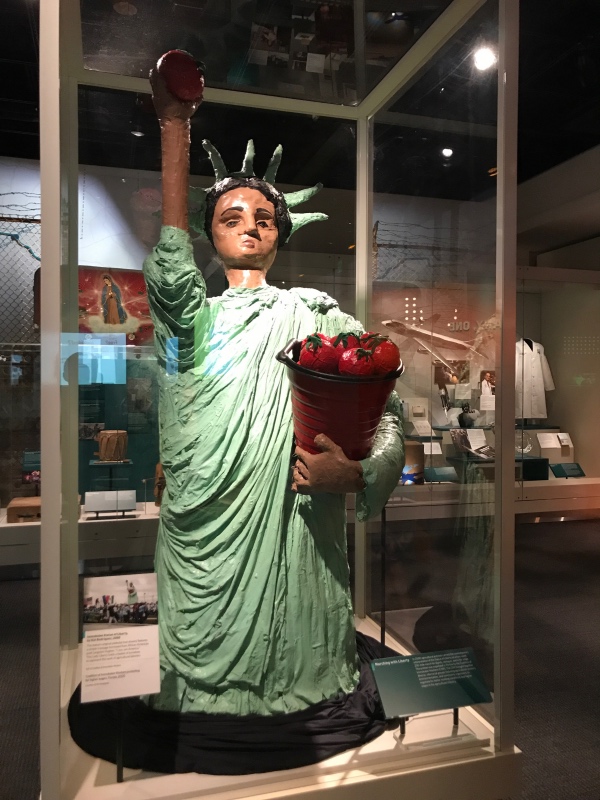
Tefillat Ha’Derekh from Montgomery Alabama
Written by Rabbi Nina H. Mandel during the T’ruah delegation to the Legacy Museum and National Memorial for Peace and Justice in Montgomery, Alabama, January 26-28, 2020
Bo
Bo el Par’oh
Come after the oppressor
Join the trouble
Muster your strength
Gird your loins
Mobilize your anger
Disrupt, disrupt, disrupt
Watch for bias
Cry out for truth
Soften your hardened heart
Embrace your neighbor
Persist, persist, persist
Ad matai? Until when?
Until there is no longer fear of justice;
Race is no longer predictive of wrongful conviction;
Poverty is no longer criminalized;
Children no longer receive life sentences.
Recommit, recommit, recommit
Until the institutions built by oppression are dismantled;
White supremacists no longer fuel antisemitism and racism;
Our diversity is embraced, not feared.
Until, until, until
May our eyes and hearts remain open as they are today,
Fired by the sights and stories of injustice.
And may this holy community continue to be a source of support and wisdom,
As we kumu, tze’u
Get up and go out to face the oppressor.
Bo.
Tefillah HaDerekh from Montgomery Alabama
Preview
More
Looking back on the 20 years since 9/11, what is the most important human rights lesson you draw from the American response to those attacks?
Rabbi Rachel Kahn-Troster
“God has told you, O person, what is good, and what the ETERNAL requires of you: Only to do justice and to love chesed, and to walk humbly with your God.” (Micah 6:8)
About ten years ago, when T’ruah started fighting to end solitary confinement, I asked a friend who was an attorney at the ACLU Prison Project why it mattered that rabbis were speaking out to end this form of torture; it seemed like the ACLU’s strategy of lawsuits and legislation would be much more effective. She replied, “We have a mercy deficit as a country, and rabbis can talk about mercy in a way that other activists cannot.” She was right: Those who speak from a moral voice can amplify the cries of those affected by abuses until they become a rallying cry for change, a demand that as a society we be motivated by chesed on an systemic level.
The rallying cry of the Jewish social movement, which emerged with such strength after 9/11—Tzedek, tdedek tirdof—occurs in Deuteronomy to elevate the significance of an impartial judiciary. But it is also a commitment to law over revenge, order over chaos. Since 9/11, the United States seems like it has mistaken one for the other. Or rather, we exact vengeance under the guise of law and justice, but in so doing achieve neither. We tortured. We substituted drone strikes for trials. We went to war to stop terror, and in so doing, decimated the countries that we believed were at fault. We killed Osama bin Laden rather than adjucating his crimes in a court of law. Each of these and so many other steps were exercises in might, acts that made us feel safe but did not in fact make us safer, in the process destroying the safety and rights of so many. It takes real humility to understand that what might feel like the right solution is actually unjust and ineffective.
That’s why I love this verse. How do we ensure that we are governed by a commitment to justice grounded in chesed? Micah orbits those commitments around a sacred path of humility. Hubris says we move forward without reckoning with the consequences of our actions. Humility requires truth and reconciliation.
Rabbi Rachel Kahn-Troster is the Executive Vice President of the Interfaith Center on Corporate Responsibility. From 2007-2021, she worked at T’ruah, most recently as Deputy Director, and directed “Honor the Image of God: A Jewish Campaign to Stop US-Sponsored Torture.”
9/11@20 and Shabbat Shuvah: Justice, Mercy, Humility
Preview
More
Looking back on the 20 years since 9/11, what is the most important human rights lesson you draw from the American response to those attacks?
Becky Jaye, Rabbinical Student
“(11) Because God has disarmed and humbled me, they have thrown off restraint in my presence. (12) Mere striplings assail me at my right hand; they put me to flight; they build their roads for my ruin. (13) They tear up my path; they promote my fall, although it does them no good. (14) They come as through a wide breach; they roll in like raging billows. (15) Terror tumbles upon me; it sweeps away my honor like the wind; my dignity vanishes like a cloud.” -- Job 30:11-15
On September 11, 2001, I was with my seventh-grade gym class in a Coney Island public school.
It is an understatement to say that the world-entire changed that day. Witnessing my friends suddenly become orphans was a stark reminder of the ephemeral nature of life, making me feel small in the vast universe.
This feeling of smallness reverberates strikingly in the Book of Job. As readers watching Job’s mounting tragedy, we also face our own powerlessness.
Not two months after 9/11, the Patriot Act was passed, limiting individual Americans’ right to privacy in an endeavor to fight the “War on Terror.” Among its goals, the Patriot Act allowed law enforcement to widen its surveillance to monitor suspected terrorism.
As a twelve-year old, I remember the distinct feeling of safety, knowing that there was at least some way -- any way -- that would prevent another attack.
Looking at the last twenty years, I cannot help but feel how Job’s cry has an eerie resonance today. As a summer intern for the Surveillance Technology Oversight Project, I have learned of the precise intensity with which government law enforcement agencies such as ICE disproportionately surveill communities of color. Our history is littered with examples of how systems to surveill communities of color--like the FBI and Dr. King--have been “roads that have led to their ruin,” humbling whole communities by stripping them of their constitutional protections. 9/11 just allowed these age-old systems to assume new forms, and our growing reliance on technology has only accelerated the trend.
As Job continues his lament with “terror,” I realize that perhaps the most important human rights lesson is how the terror we feel impacts us. In my most formative years, I didn’t speak up against xenophobic policies because I was prioritizing my own safety. In the comfort of my complacency and my submission to fear, I not only aided in the diminishing of others’ human dignity, but I damaged my own dignity as well.
Hosea 14:9 states, “One who is wise will consider these words, One who is prudent will take note of them. For the paths of the ETERNAL are smooth; the righteous can walk on them, while sinners stumble on them.” Too long have we traveled roads that ensure only the racially and economically privileged reach the most desired destinations. Most times, we have been unaware that we even do so. On this anniversary, I wish to return to the day before, to begin again, to smooth those roads that may honor the righteousness of each human able to travel them.
Becky Jaye will be ordained a rabbi by HUC-JIR in New York in 2022. Her internship at S.T.O.P. is part of her participation in T’ruah’s Rabbinical/Cantorial Student Summer Fellowship in Human Rights Leadership.
9/11@20 and Shabbat Shuvah: Surveillance and Racial Justice
Preview
More

9/11@20 and Shabbat Shuvah: Human Rights at Home
Preview
More
Traditional Jewish services are full of lines—sometimes whole paragraphs—about freedom and redemption. When read with an eye towards mass incarceration, many hitherto unremarkable lines jump out at us, clamoring for attention. We offer the following selection from the morning service as an invitation for meditation and contemplation, study and preaching, or song and chanting. We hope these—and others like them— find a use in the synagogue, the classroom, and out on the streets.
From the birkhot hashachar, morning blessings:
Barukh atah Adonai. Eloheinu melekh ha’olam
Sheh asani bat/ben-horin
Matir asurim
Zokef ke’fu’fim
Sheh asani kol’tzarki
Ha’meichin meh’tza’di gaver
Ha’notein l’ayef koach
We praise you, Eternal God, Sovereign of the universe, who
made me free
releases the imprisoned
lifts up the bent-over
provides for all my needs
supports a person’s steps
gives strength to the weary
From the paragraph immediately preceding Mi Chamocha:
Exalted and High, Mighty and Awesome, You bring low the proud and lift up the fallen; You free the imprisoned, redeem the humble, and help the poor.
From Psalm 85, Verse 12:
May truth spring up from the ground; may justice look down from heaven.
Jewish Sources for Praying to an End to Mass Incarceration
Preview
More
Tefillat Ha’Derekh from Montgomery Alabama
Written by Rabbi Nina H. Mandel during the T’ruah delegation to the Legacy Museum and National Memorial for Peace and Justice in Montgomery, Alabama, January 26-28, 2020
Bo
Bo el Par’oh
Come after the oppressor
Join the trouble
Muster your strength
Gird your loins
Mobilize your anger
Disrupt, disrupt, disrupt
Watch for bias
Cry out for truth
Soften your hardened heart
Embrace your neighbor
Persist, persist, persist
Ad matai? Until when?
Until there is no longer fear of justice;
Race is no longer predictive of wrongful conviction;
Poverty is no longer criminalized;
Children no longer receive life sentences.
Recommit, recommit, recommit
Until the institutions built by oppression are dismantled;
White supremacists no longer fuel antisemitism and racism;
Our diversity is embraced, not feared.
Until, until, until
May our eyes and hearts remain open as they are today,
Fired by the sights and stories of injustice.
And may this holy community continue to be a source of support and wisdom,
As we kumu, tze’u
Get up and go out to face the oppressor.
Bo.
Tefillah HaDerekh from Montgomery Alabama
Preview
More
Looking back on the 20 years since 9/11, what is the most important human rights lesson you draw from the American response to those attacks?
Rabbi Rachel Kahn-Troster
“God has told you, O person, what is good, and what the ETERNAL requires of you: Only to do justice and to love chesed, and to walk humbly with your God.” (Micah 6:8)
About ten years ago, when T’ruah started fighting to end solitary confinement, I asked a friend who was an attorney at the ACLU Prison Project why it mattered that rabbis were speaking out to end this form of torture; it seemed like the ACLU’s strategy of lawsuits and legislation would be much more effective. She replied, “We have a mercy deficit as a country, and rabbis can talk about mercy in a way that other activists cannot.” She was right: Those who speak from a moral voice can amplify the cries of those affected by abuses until they become a rallying cry for change, a demand that as a society we be motivated by chesed on an systemic level.
The rallying cry of the Jewish social movement, which emerged with such strength after 9/11—Tzedek, tdedek tirdof—occurs in Deuteronomy to elevate the significance of an impartial judiciary. But it is also a commitment to law over revenge, order over chaos. Since 9/11, the United States seems like it has mistaken one for the other. Or rather, we exact vengeance under the guise of law and justice, but in so doing achieve neither. We tortured. We substituted drone strikes for trials. We went to war to stop terror, and in so doing, decimated the countries that we believed were at fault. We killed Osama bin Laden rather than adjucating his crimes in a court of law. Each of these and so many other steps were exercises in might, acts that made us feel safe but did not in fact make us safer, in the process destroying the safety and rights of so many. It takes real humility to understand that what might feel like the right solution is actually unjust and ineffective.
That’s why I love this verse. How do we ensure that we are governed by a commitment to justice grounded in chesed? Micah orbits those commitments around a sacred path of humility. Hubris says we move forward without reckoning with the consequences of our actions. Humility requires truth and reconciliation.
Rabbi Rachel Kahn-Troster is the Executive Vice President of the Interfaith Center on Corporate Responsibility. From 2007-2021, she worked at T’ruah, most recently as Deputy Director, and directed “Honor the Image of God: A Jewish Campaign to Stop US-Sponsored Torture.”
9/11@20 and Shabbat Shuvah: Justice, Mercy, Humility
Preview
More
Looking back on the 20 years since 9/11, what is the most important human rights lesson you draw from the American response to those attacks?
Becky Jaye, Rabbinical Student
“(11) Because God has disarmed and humbled me, they have thrown off restraint in my presence. (12) Mere striplings assail me at my right hand; they put me to flight; they build their roads for my ruin. (13) They tear up my path; they promote my fall, although it does them no good. (14) They come as through a wide breach; they roll in like raging billows. (15) Terror tumbles upon me; it sweeps away my honor like the wind; my dignity vanishes like a cloud.” -- Job 30:11-15
On September 11, 2001, I was with my seventh-grade gym class in a Coney Island public school.
It is an understatement to say that the world-entire changed that day. Witnessing my friends suddenly become orphans was a stark reminder of the ephemeral nature of life, making me feel small in the vast universe.
This feeling of smallness reverberates strikingly in the Book of Job. As readers watching Job’s mounting tragedy, we also face our own powerlessness.
Not two months after 9/11, the Patriot Act was passed, limiting individual Americans’ right to privacy in an endeavor to fight the “War on Terror.” Among its goals, the Patriot Act allowed law enforcement to widen its surveillance to monitor suspected terrorism.
As a twelve-year old, I remember the distinct feeling of safety, knowing that there was at least some way -- any way -- that would prevent another attack.
Looking at the last twenty years, I cannot help but feel how Job’s cry has an eerie resonance today. As a summer intern for the Surveillance Technology Oversight Project, I have learned of the precise intensity with which government law enforcement agencies such as ICE disproportionately surveill communities of color. Our history is littered with examples of how systems to surveill communities of color--like the FBI and Dr. King--have been “roads that have led to their ruin,” humbling whole communities by stripping them of their constitutional protections. 9/11 just allowed these age-old systems to assume new forms, and our growing reliance on technology has only accelerated the trend.
As Job continues his lament with “terror,” I realize that perhaps the most important human rights lesson is how the terror we feel impacts us. In my most formative years, I didn’t speak up against xenophobic policies because I was prioritizing my own safety. In the comfort of my complacency and my submission to fear, I not only aided in the diminishing of others’ human dignity, but I damaged my own dignity as well.
Hosea 14:9 states, “One who is wise will consider these words, One who is prudent will take note of them. For the paths of the ETERNAL are smooth; the righteous can walk on them, while sinners stumble on them.” Too long have we traveled roads that ensure only the racially and economically privileged reach the most desired destinations. Most times, we have been unaware that we even do so. On this anniversary, I wish to return to the day before, to begin again, to smooth those roads that may honor the righteousness of each human able to travel them.
Becky Jaye will be ordained a rabbi by HUC-JIR in New York in 2022. Her internship at S.T.O.P. is part of her participation in T’ruah’s Rabbinical/Cantorial Student Summer Fellowship in Human Rights Leadership.
9/11@20 and Shabbat Shuvah: Surveillance and Racial Justice
Preview
More

9/11@20 and Shabbat Shuvah: Human Rights at Home
Preview
More
Traditional Jewish services are full of lines—sometimes whole paragraphs—about freedom and redemption. When read with an eye towards mass incarceration, many hitherto unremarkable lines jump out at us, clamoring for attention. We offer the following selection from the morning service as an invitation for meditation and contemplation, study and preaching, or song and chanting. We hope these—and others like them— find a use in the synagogue, the classroom, and out on the streets.
From the birkhot hashachar, morning blessings:
Barukh atah Adonai. Eloheinu melekh ha’olam
Sheh asani bat/ben-horin
Matir asurim
Zokef ke’fu’fim
Sheh asani kol’tzarki
Ha’meichin meh’tza’di gaver
Ha’notein l’ayef koach
We praise you, Eternal God, Sovereign of the universe, who
made me free
releases the imprisoned
lifts up the bent-over
provides for all my needs
supports a person’s steps
gives strength to the weary
From the paragraph immediately preceding Mi Chamocha:
Exalted and High, Mighty and Awesome, You bring low the proud and lift up the fallen; You free the imprisoned, redeem the humble, and help the poor.
From Psalm 85, Verse 12:
May truth spring up from the ground; may justice look down from heaven.
Jewish Sources for Praying to an End to Mass Incarceration
Preview
More
showing
1-6
of
48
Page
1
of
8

The Other Side of the River, the Other Side of the Sea, by T'ruah
Preview